
Baghdadi Cafe
Baghdadi Heritage Museum
“The Baghdadi Cafe” then and now is far more than just a place for tea or coffee. It is an open, popular club where men and youths of the neighborhood, craftsmen, and merchants gather, forming a tightly knit social fabric that reflects Baghdad’s life across different eras.
The first cafe in Baghdad dates back to 1590. Cafes were unknown during the Abbasid period and first appeared in customs warehouses connected to the Mustansiriya School. The scene then evolved: in 1604, Hasan Pasha’s Cafe was built near the Wazir Mosque, and by 1834, Baghdad was bustling with cafes, which had become hubs for entertainment and popular interaction.
Cafes welcomed both young and old. Some patrons smoked the “nargila” (hookah), others sipped Iraqi tea or coffee. Games like chess and “tawli” (backgammon) were played, and captivating tales were told by “qassasin” “professional storytellers). “Iraqi maqam music” had a strong presence in cafes until the arrival of photography, radio, and television.
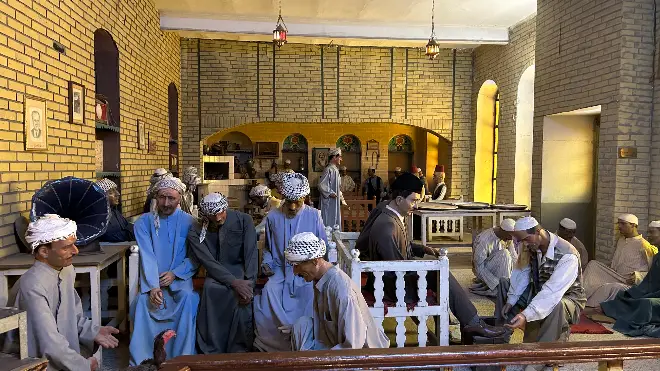
In a remarkable visual reenactment of cafe heritage, lifelike statues portray iconic Baghdadi cafe scenes:
•The Grilled Liver Vendor: Standing in a corner, grilling liver over charcoal is a beloved delicacy served in cafes, especially with bread and spices.
•The Cockfight Wager: A snapshot of an old betting tradition, where two “Harati” (cocks a prized Indian breed) fight. The loser must buy grilled liver for the winner, a common practice at the time.
•The “Afaandi” and the Shoeshiner: Another statue shows an elegant “afaandi” (a symbol of the educated middle class) seated with poise as a shoeshiner tends to his shoes, a daily cafe scene reflecting social interaction.
•”Siniyah” (The Tray Game): A vivid statue of one of the most popular memory and luck games. Inverted cups are arranged on a tray with small objects hidden underneath. After swift, skillful shuffling, players must guess where the items are hidden.
Behind the cockfight statues, a group of young men is depicted playing “Mahibis” one of Iraq’s most beloved group games, especially during Ramadan.
“Mahibis” are played between two teams. “Mahbis” (a ring) is secretly hidden in the hand of a player from the first team, while everyone keeps their hands closed. The opposing team must guess which hand holds the ring, relying on facial cues and subtle gestures. A point is awarded for each correct guess, and the game continues through multiple rounds until a team accumulates the most points.
To this day, traditional cafes remain a fixture in Baghdad, bearing witness to a long history of gathering, play, conversation, and artistry. Each cafe is like a miniature stage, portraying scenes from everyday heritage and standing as a vital element in understanding the rich social life of old Baghdad.
Baghdadi Cafe
Arabic · English
Hear this stop narrated — free in the app
Get app