
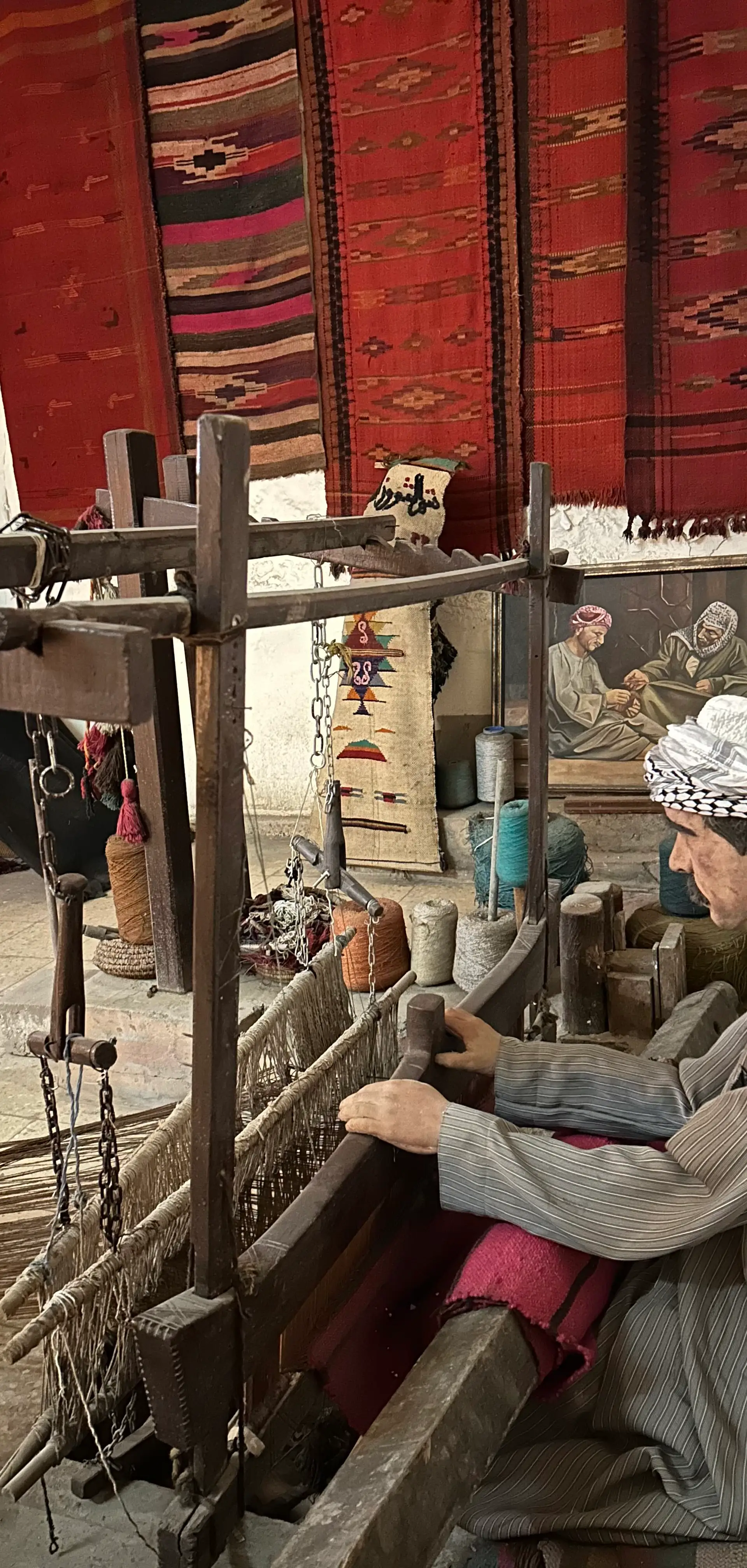
The Baghdadi Weaver
Baghdadi Heritage Museum
In old Baghdad, the profession of “the weaver" was among the most prominent folk occupations, playing an important role in people's daily lives through the manual production of textiles using the traditional loom.
"The Baghdadi Weaver" mastered transforming cotton, woolen, or silk threads into fabrics used in making clothes, covers, and carpets. This craft formed a primary source for the clothing worn by common people, making it a necessary profession in Baghdadi society at that time.
With the advent of the industrial age and the development of modern machinery, this profession began to gradually decline. However, it is still considered an important part of Baghdadi folk heritage, retaining its place in cultural memory and sometimes being displayed at festivals or museums.
Through heritage photographs, one can see men wearing traditional clothing and working on "hand looms", the main tool in the weaving process. Geometric patterns also appear on some frames or pieces, traditional textile designs used in making Iraqi carpets, rugs, floor coverings, and shawls.
These ornamentations are not merely aesthetic elements, but carry the imprint of place and identity, reflecting the artistic patterns for which Baghdad and other Iraqi regions were famous. The weaver's profession remains a witness to the precision of the Iraqi hand and the richness of its living heritage.
The Baghdadi Weaver
Arabic · English
Hear this stop narrated — free in the app
Get app