
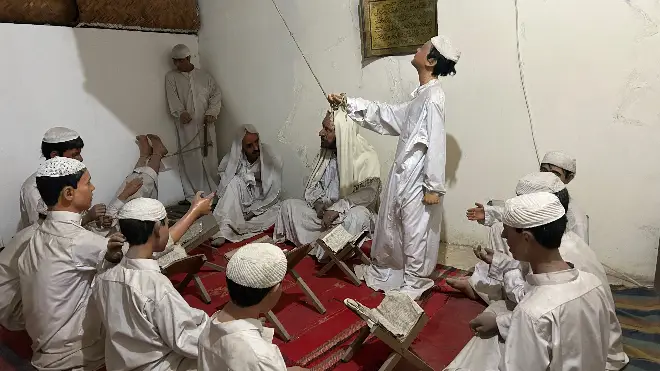
The Mullah and The Childern
Baghdadi Heritage Museum
The mulla was one of the early pioneers who confronted illiteracy in the city of Baghdad. He taught children the Arabic alphabet and established a traditional style of education that remained firmly rooted for centuries. During the Abbasid era, the mulla was regarded as a monumental teacher bursting with knowledge and culture, and possessing a willpower that would rival even 20th-century educators. His school reportedly accommodated nearly three thousand students, and he would ride a donkey to move between sections of his institute, supervising lessons and observing student behavior.
Even as the caliphate declined, the mulla continued his educational mission, defying hardship while maintaining his broad smile. He taught his pupils the basics of reading, writing, and the four arithmetic operations, while they sat on reed mats in modest surroundings. Despite the simplicity, the mulla held broad authority in discipline and behavioral management.
The children of Baghdad grew accustomed to staying under the mulla’s supervision from sunrise to sunset until modern schools began to spread. Over time, children gradually moved away from this traditional system, and Baghdad entered a new era of formal education.
The Mullah and The Childern
Arabic · English
Hear this stop narrated — free in the app
Get app